What is a Sovereignpreneur?
A person in the constant process of building their life on rails they own.
Not someone who's arrived — someone who's moving. One component at a time, doing the best they can from wherever they actually start. Their money, their tools, their attention, their time… and eventually the harder question of what all that freedom is for.
The word fuses three things that usually live apart. The sovereign individual — who depends on no permission system they didn't choose. The entrepreneur — who builds and directs leverage instead of renting it. And the part neither word carries: a person who stopped fighting the old system and started building the way out instead.
You don't have to be 100% there. Almost no one is. Awareness is the entry point — the moment you see the rails you're standing on, and decide to start owning them, one rung at a time.
00 the contrast
Why not just "entrepreneur"?
Because that word was built for a world that's ending — one of scarcity, permission, and gatekeepers.
The entrepreneur built businesses inside the old system. Dependent on permission — banks, platforms, gatekeepers — and treating freedom as a retirement goal, something you'd cash out into later, if the exit ever came.
The sovereignpreneur is keyed to a different paradigm. The old one is scarcity — and most economic, political, and personal thinking is still wired to it. The new one is abundance. Most people aren't equipped to live well in it, because every reflex they have was trained for scarcity and permission. The shift isn't a tactic. It's a change in what you build on, who you depend on, and what you're building toward.
You don't reform the old script from the inside. You turn around and choose a different one — rails you own, terms you can exit.
And choosing it is Proof of Work, not a wish. You don't manifest the new track — you mine it: real, costly, directional energy spent toward it, one component at a time. That's the difference between a sovereignpreneur and someone who just wants out. One is building. The other is hoping.
01 how you become one
The Sovereignpreneur Stack
Four tiers, ordered by dependency. Each one presupposes the one beneath it.
If the definition is the who, the Stack is the how. It's the curriculum for building your life on rails you own — not a vibe, a sequence. You don't start with tactics. You start with substrate, and build up. The order is the whole point.
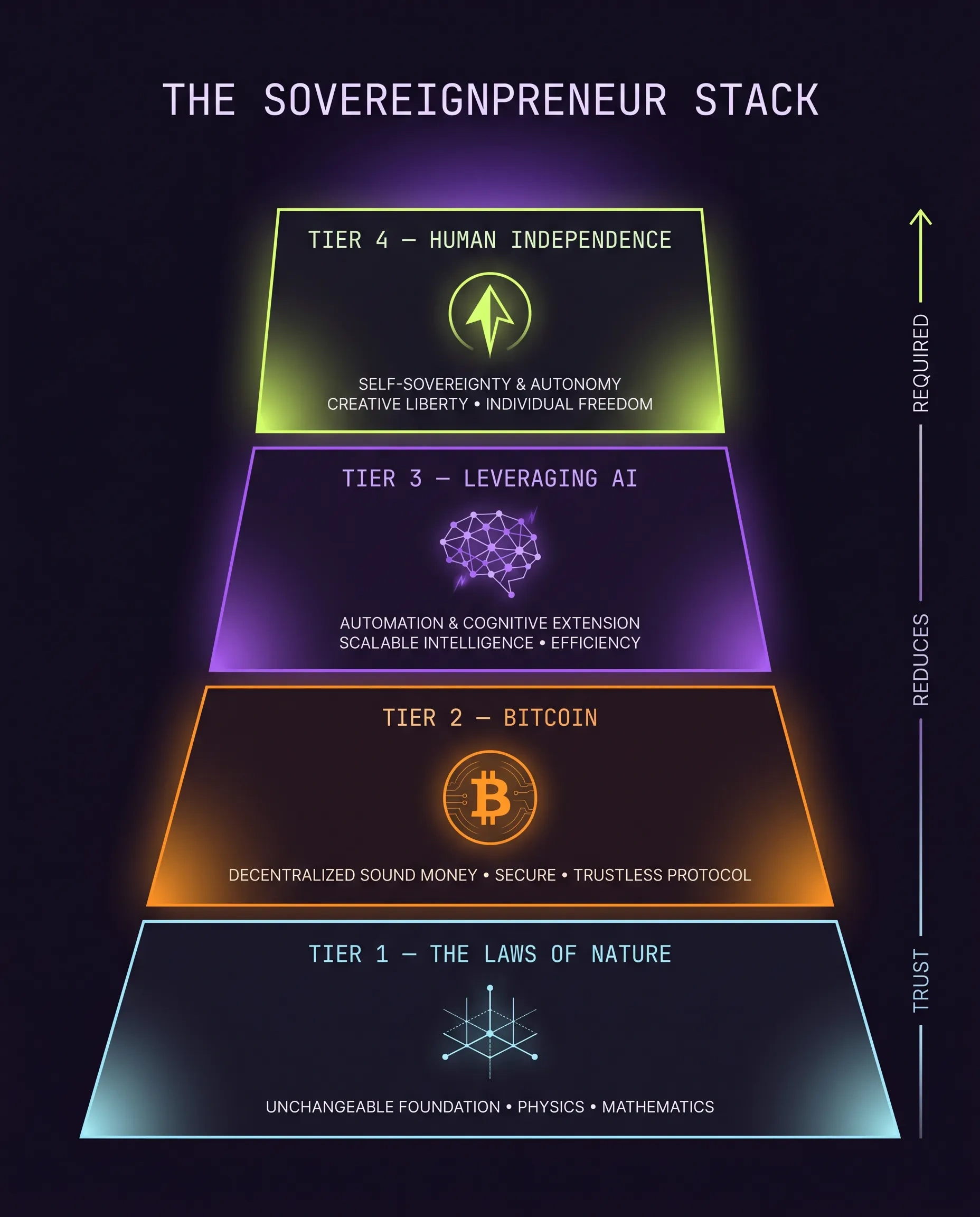
The Laws of Nature
Physics, materialism, Austrian economics. Every other tier rests on the assumption that reality has rules and economics is a subset of those rules. Begin with substrate, not tactics.
Bitcoin
The peer-to-peer money protocol — decentralized, permissionless, neutral. If Tier 1 explains why sound money matters, Bitcoin is the only sound money that exists. Everything built on unsound money inherits its rot.
Leveraging AI
Intelligence as a force multiplier. The first general-purpose leverage tool that scales cognition the way machines scaled muscle. Rent frontier reasoning when depth matters; own smaller inference for speed. Dogma in either direction is anti-leverage.
Human Independence
What to do with freedom once you have it. Most people who reach it aren't equipped for it — every habit they own was trained for scarcity and permission. Freedom is not the answer; it's the question. This is where the Sovereignpreneur becomes a person, not just an actor.
Skip Tier 4 → you become free and miserable. The most common failure mode.
The order is fixed for a reason. Skip Tier 1 and you make decisions that violate physics and time preference. Skip Tier 2 and your leverage compounds on a debased base — running faster on a treadmill. Skip Tier 3 and you're correct but slow. Skip Tier 4 and the whole thing was for nothing.
02 where you actually are
The Sovereignty Ladder
The Stack is the curriculum. The Ladder is the gradient — almost no one starts at the top, and pretending otherwise is dishonest.
This is what the Ladder measures — not where you've arrived, but how far you've climbed on purpose. Remember: you don't have to be at the top to be a sovereignpreneur. You have to be moving, aware of which rung you're on and which one is next.
Most people begin with very little sovereignty. Their money sits with a bank. Their compute sits with a cloud provider. Their intelligence access sits with one or two AI labs. That's not shameful — it is the starting position. The work is to ascend one rung at a time, not to teleport.
| Rung | Money | Intelligence (AI) | Data & Devices |
|---|---|---|---|
| 0 · Default | Bank, payment apps | Closed frontier APIs only — one or two labs hold your prompts | Everything in Big Tech clouds; stock phone, ISP router |
| 1 · Awareness | Some BTC on an exchange | Subscriptions used deliberately, not by default; you know what leaves your machine | Password manager + 2FA; regular cloud exports |
| 2 · Custody | Self-custody hardware wallet | Decentralized / private inference (Venice, Akash) — frontier access, identity decoupled from prompts | Local-first files; encrypted 3-2-1 backups; E2E messaging |
| 3 · Verify | Running a Bitcoin node | Routing across providers by task; owning a piece of inference (tokenized credits), not just renting | Own domain for email/identity; client-side encryption |
| 4 · Operate | Lightning node, channels, payments | Self-hosted mid-size open models for daily and agentic work — no metering, nothing logged | First self-hosted services on a box you own; DNS blocking |
| 5 · Stack | Multi-sig, time locks, inheritance | Self-hosted high-parameter models for the workloads they fit; rented datacenter GPUs for the frontier ones | Full self-hosted suite; open router firmware; de-Googled phone |
| 6 · Compose | Bitcoin-denominated life | Every task routed to the lowest-trust tier that can do it — owned models first, rented frontier only when needed | Data on owned hardware by default; cloud by exception |
Numbers are illustrative, not gospel. The point is the direction.
The two columns aren't symmetric, and the page won't pretend they are. You can climb money all the way to trustless — a node and your own keys, depending on no one. You can't climb intelligence that far yet: the genuinely frontier models still run on rented or datacenter hardware, not a box in your closet. On consumer gear today you get close — strong, private, owned — but not equal. Naming that gap honestly is the whole point; pretending it's closed is the dogma we reject.
Three truths hold the ladder together:
- Bitcoin is trustless. AI inference is not (yet). You can climb the money side until you depend on no third party. You cannot, today, climb the AI side that high — the best models don't run on consumer hardware. The two ladders are not symmetric.
- Each rung must be lived, not just bought. A node you never reconcile isn't Rung 3. A GPU that idles isn't Rung 4. A NAS full of un-restored backups isn't either. The ladder is climbed by use, not by purchase.
- Data & devices is the fully climbable column. Every rung there has a mature, open-source answer today. The cost is time, not capability — "a weekend of setup" is a real price, and pretending otherwise burns trust.
Asymmetry across columns creates fragility. Don't run a Rung 5 AI setup on a Rung 0 money setup.
03 the lens
The Trust Spectrum
The single most important decision-making lens. Every tool, product, service, and partnership gets evaluated here first.
Trustless — you depend on no third party. The system works whether or not anyone else is honest, solvent, or online. Run a node, hold your keys, verify the chain: no institution stands between you and your money.
Trusted third party (TTP) — you depend on someone else's continued existence and good behavior. Banks, exchanges, SaaS, API providers, custodians, hosted LLMs. Convenient. Sometimes necessary. Always a counterparty risk.
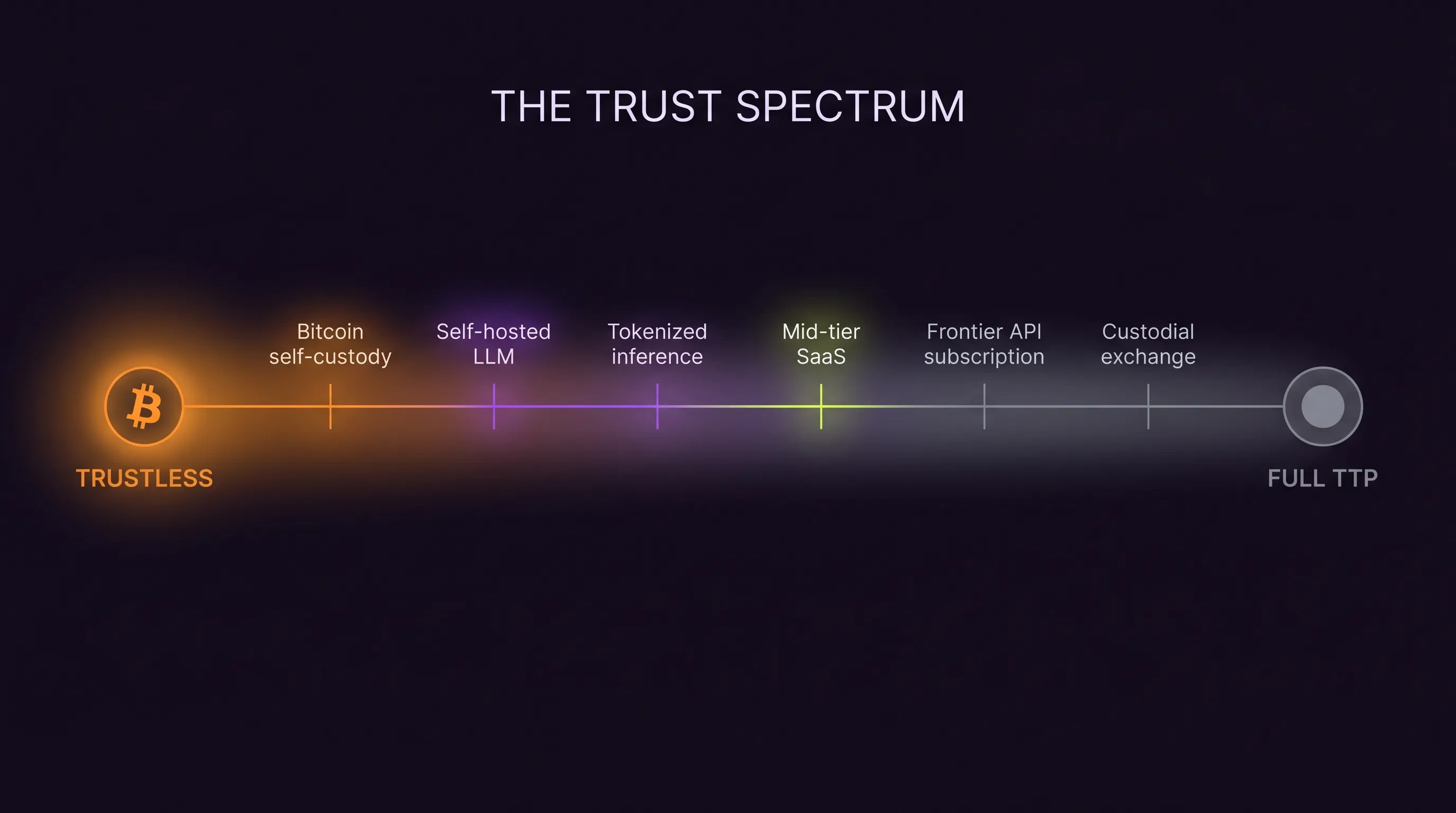
The spectrum measures how much of what you depend on is promise, and how much is physics.
Paper guarantees are enforced by institutions — contracts, terms of service, a company's reputation. They hold as long as someone chooses to honor them. Bedrock guarantees are enforced by mathematics and physics — a private key, a hash, proof of work. They hold whether or not anyone is honest, solvent, or even watching. "Trustless" is just the word for systems whose guarantees are bedrock.
When evaluating any tool, ask in order:
- Is there a trustless option that's good enough? If yes, use it.
- If not, what's the failure mode of the TTP? What happens to you if it shuts down, gets acquired by an actor with different values, censors you, or is compelled by a state to act against you?
- What's your exit cost? Can you leave with your data, workflows, and customers — or are you locked in by proprietary formats and network effects?
- What's the trust-to-leverage ratio? A one-month Claude subscription buys enormous leverage for modest trust. A custodial wallet holding your life savings does not. Match the trust granted to the leverage gained.
- Can you climb the ladder later? Today's TTP can be tomorrow's self-hosted setup. Choose tools that don't trap you at your current rung.
The sharp asymmetry: money has a working, decade-tested trustless solution — Bitcoin. Choosing a TTP for your monetary base is a choice, and it's the wrong one. Intelligence does not have a trustless equivalent at the frontier yet. Choosing a TTP for some AI workloads is currently a constraint, not a choice — pretending otherwise is the dogma we reject.
Naïve trust is the enemy. Considered, time-boxed, exit-aware trust is fine.